
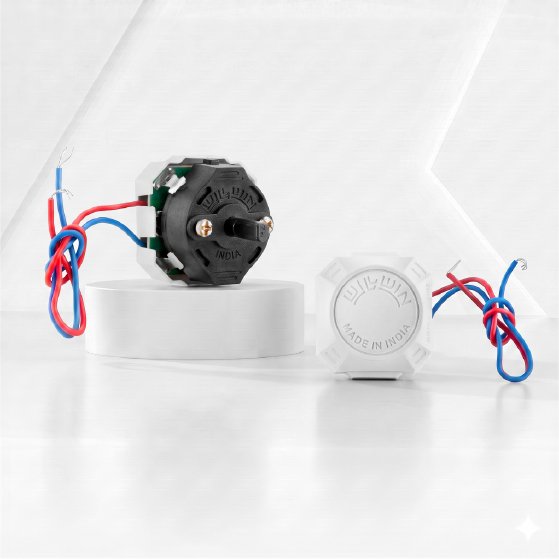
Users want low, medium and high. But many cooler motors are built with a single speed winding, and a multi-speed motor costs more. The answer most cooler makers use is a rotary switch with a built-in resistance. Here’s how it works and what to check before you specify one.
How it works
A single-speed motor runs at full speed on full mains voltage. Put a resistance in series with it and part of the voltage drops across the resistance, so the motor gets less and turns slower.
A 3-speed rotary switch with resistance does this in steps:
- High: the motor is connected straight to the supply — full speed.
- Medium: current passes through part of the resistance — lower speed.
- Low: current passes through more of the resistance — lowest speed.
Turning the knob simply chooses how much resistance sits in the circuit. No change to the motor is needed.
Why makers choose it
- Lower cost than a multi-speed motor across a full production run.
- One motor, many models — the same single-speed motor can go into a basic one-speed cooler or a three-speed model, just by changing the switch.
- Simple service — the switch is one part, easy to replace.
What to check before you buy
Motor compatibility. The resistance values must suit the motor. A resistance meant for a different motor gives speeds that are too close together, or a low speed that won’t start the fan. Our 503 Rotary Switch with Resistance is made for 89 dia 25 mm motors and is also available for KIT motors.
Rating. The switch must carry the motor’s current with headroom. The 503 with Resistance is rated 250V – 6A.
Pre-wired, tested harness. Resistance wired by hand on the assembly line is a common source of loose joints. Ours comes with a factory-fitted resistance harness on 0.5 mm tin-plated terminals, pre-wired and tested before dispatch.
Body material. The resistance runs warm. A 30% glass-filled nylon body stays rigid when warm, where plain plastic can soften.
Placement. Mount the resistance where air moves over it, away from the water tank, and never wrap it in tape or foam.
Fitting and safety
Wiring a mains switch into a cooler is a job for a trained technician or the assembly line, following the wiring sheet supplied with the switch. Always unplug the cooler before opening the control panel. Never bypass the resistance or join wires without proper terminals.
If a cooler’s fan works on high but not on low, the resistance or its connection is the usual suspect — replace the switch assembly rather than repairing the resistance. If the fan runs but the cooler doesn’t cool, the problem is more likely the pump — see our cooler pump troubleshooting guide.
Frequently asked questions
Can I make my single-speed cooler three-speed?
Yes, with a rotary switch with resistance matched to your motor. Have a technician fit it.
Why does my cooler run only on high speed?
On a resistance-type switch, a failed resistance or loose connection usually leaves only the direct (high) position working.
Does a resistance speed switch waste electricity?
Some energy is lost as heat in the resistance at lower speeds, but the motor draws less overall than at high speed.
Which motors does the 503 with Resistance fit?
89 dia 25 mm motors; a version is also available for KIT motors.
Speak to our switch team
Tell us your motor model and the speeds you want, and we’ll confirm the right switch. Read our rotary switch buyer’s guide, browse all rotary switches, or contact Willwin India.
